Weightless: The Science and Skill of Mastering Neutral Buoyancy
6 May 2026technical
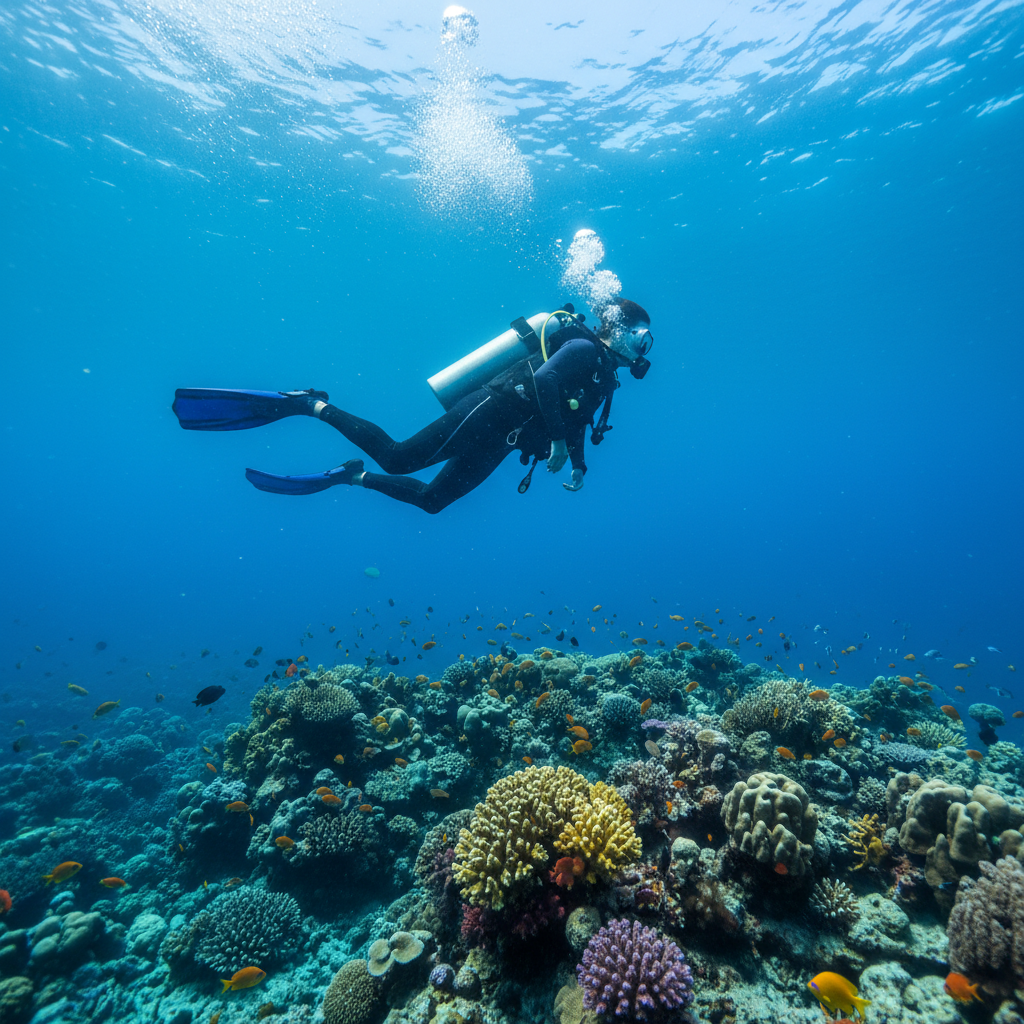
Neutral buoyancy is the single most transformative skill a diver can develop — separating those who fight the water from those who flow through it. Whether you're on scuba or freediving, here's the physics, physiology, and practical technique to finally nail it.
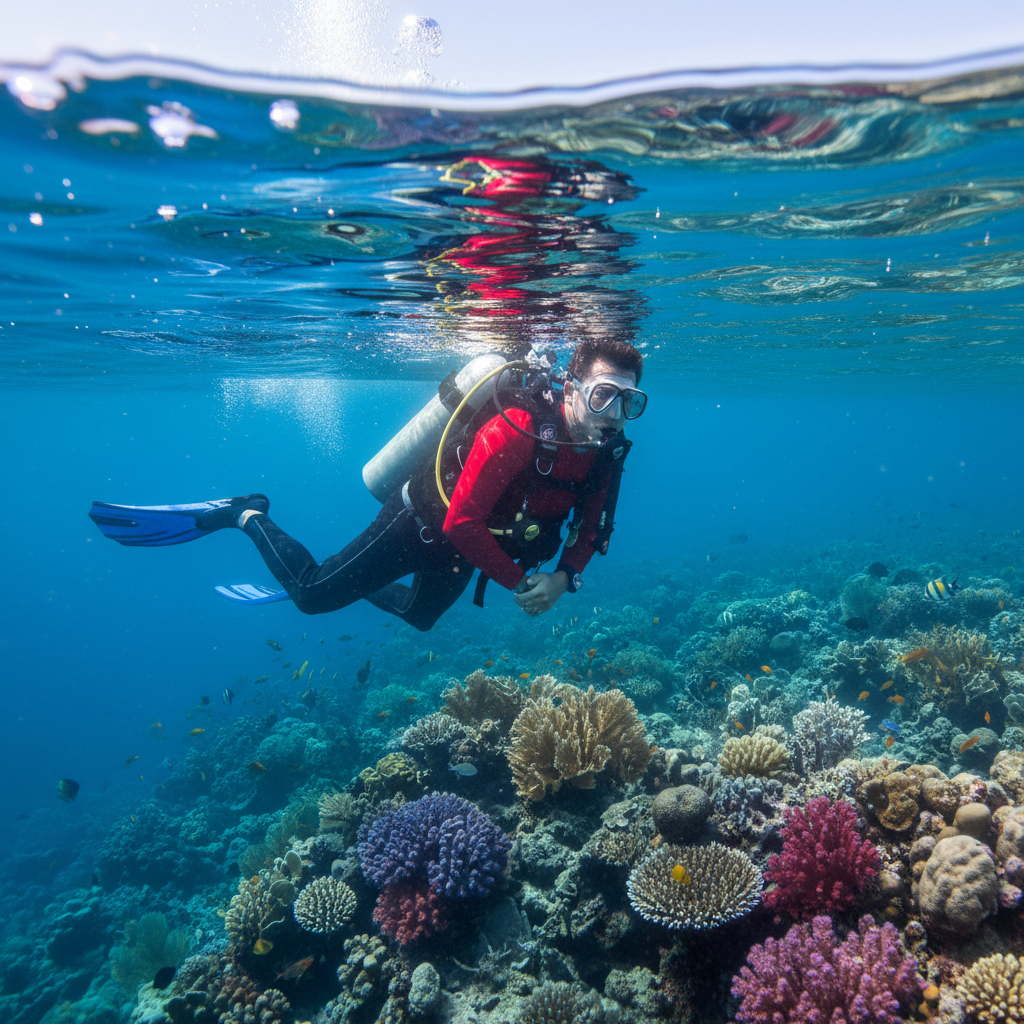
Why Buoyancy Is Everything (And Why Most Divers Get It Wrong)
Ask any experienced diver what separates a nervous beginner from a confident, graceful underwater explorer, and the answer is almost always the same: buoyancy control. It's the foundation of every great dive — not just for comfort or elegance, but for safety, air consumption, marine conservation, and physical efficiency. Yet a surprisingly high proportion of recreational divers — even those with dozens of logged dives — never fully master it.
The core problem is that buoyancy is a dynamic system, not a static setting. Your buoyancy changes with every breath, every metre of depth, every kilogram of gear, and even the salinity of the water you're diving in. Seawater is denser than freshwater — approximately 1,025 kg/m³ versus 1,000 kg/m³ — which means you'll float more easily in the ocean than in a freshwater lake or quarry. Overlook this when transitioning between environments and you'll find yourself unexpectedly sinking or soaring.
For scuba divers, improper buoyancy leads to dramatically increased air consumption, accidental contact with coral, and dangerous uncontrolled ascents. For freedivers, poor buoyancy management means wasted energy on every dive — energy that, at depth, is the difference between a comfortable dive and a dangerous one. Getting it right isn't just about looking polished. It's about diving smarter and safer.
The Physics Behind the Float: Archimedes in Your BCD
Neutral buoyancy is simply the state in which the upward buoyant force acting on your body exactly equals the downward force of gravity — or more precisely, where the weight of water you displace equals your own total weight (body, wetsuit, cylinder, weights, and all gear combined). This is Archimedes' Principle, and it governs every moment you spend underwater.
Your body itself is close to neutrally buoyant — human tissue averages roughly 985 kg/m³, meaning most people float naturally in saltwater but sink slightly in fresh. The complication comes from gear. A steel 12-litre cylinder can weigh 3–4 kg negatively buoyant when full, but as gas is consumed that negative effect diminishes. A 5mm wetsuit, conversely, adds significant positive buoyancy due to trapped nitrogen gas in the neoprene foam — typically 4–8 kg of lift depending on thickness and fit. And critically, that neoprene compresses under pressure: at 30 metres, a wetsuit provides roughly half the buoyancy it does at the surface.
This depth-dependent buoyancy shift is one of the most underappreciated challenges for beginner scuba divers. You carefully dial in your weight at the surface and feel perfectly balanced — then at 20 metres, you're sinking. This is entirely normal, and it's why your BCD (Buoyancy Control Device) exists: to compensate for that lost wetsuit lift with air volume. The skill lies in making these adjustments gradually, precisely, and in sync with your breathing.
Scuba Technique: The Hover, the Breath, and the Trim
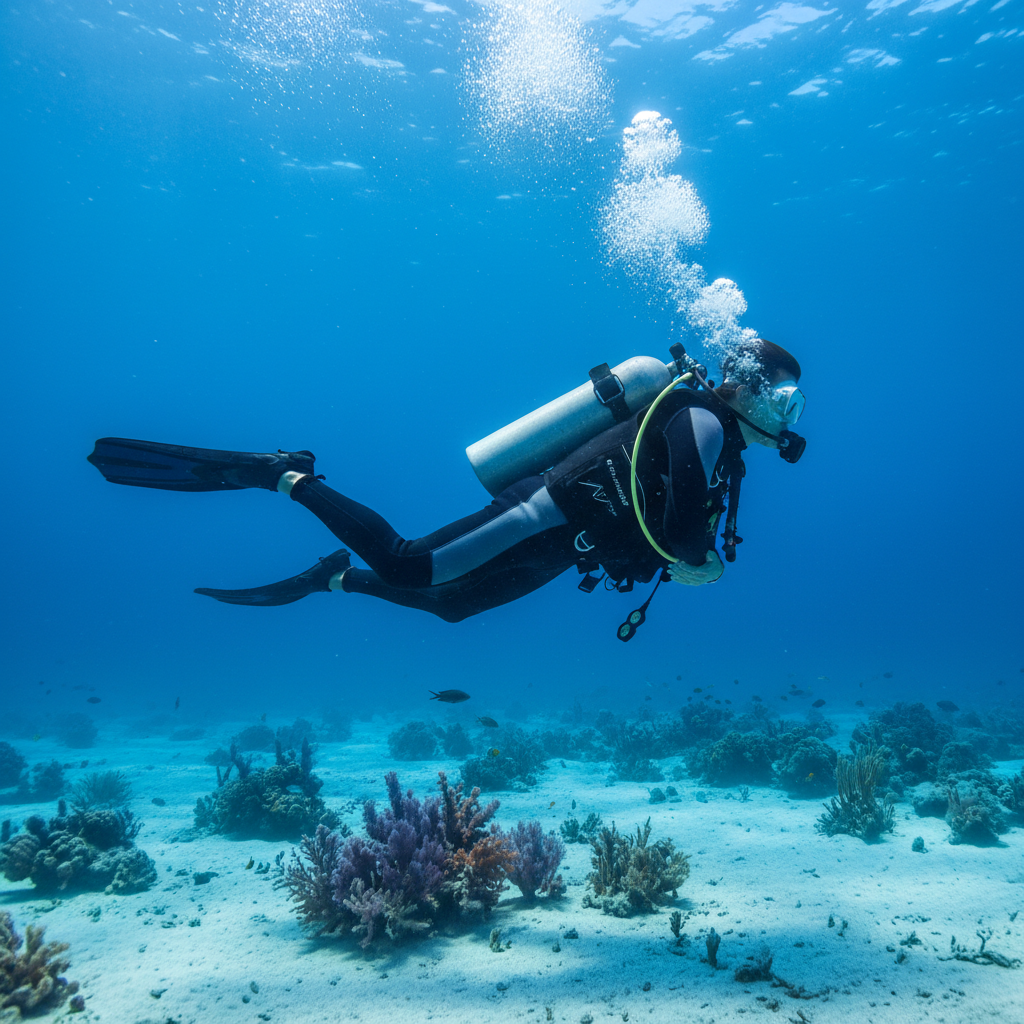
For scuba divers, neutral buoyancy is a three-part discipline: weighting, trim, and breath control. Nail all three and you'll hover motionless in the water column without touching a fin to the seafloor.
Start with correct weighting. Many recreational divers are chronically over-weighted — it's a legacy of conservative open-water training. The standard surface buoyancy check is your calibration tool: with a nearly empty cylinder (less than 50 bar), deflated BCD, and normal breath, you should float at eye level and begin to sink when you exhale. Use this check every time you change wetsuits, cylinders, or dive locations. Consider switching from lead block weights to distributed trim weights (in backplate pockets or integrated BCD pockets at the hips) to improve horizontal trim — a body position parallel to the seafloor rather than feet-low, which dramatically reduces drag and silting.
Once weighted correctly, your lungs become your fine-tuning tool. In neutral buoyancy, a slow, controlled inhale will gently lift you; a full exhale will ease you down. Practice 'lung breathing' — using respiratory cycle rather than BCD inflation for small positional adjustments during a dive. Reserve your BCD for larger changes between depths. Many dive professionals recommend the 'PADI hover exercise': deploy your SMB or simply hold position mid-water for 30 seconds without touching anything. If you're drifting, make one small BCD adjustment and then stop — resist the temptation to constantly add or dump air, which creates an oscillating yo-yo effect. Patience is the skill.
Freediving Buoyancy: Passive Descent and the Neutral Point
For freedivers, buoyancy control is an entirely different — and arguably more elegant — challenge. Unlike scuba divers, freedivers cannot add or dump gas mid-dive. Their buoyancy profile is set before they enter the water, and it changes dramatically and predictably with depth.
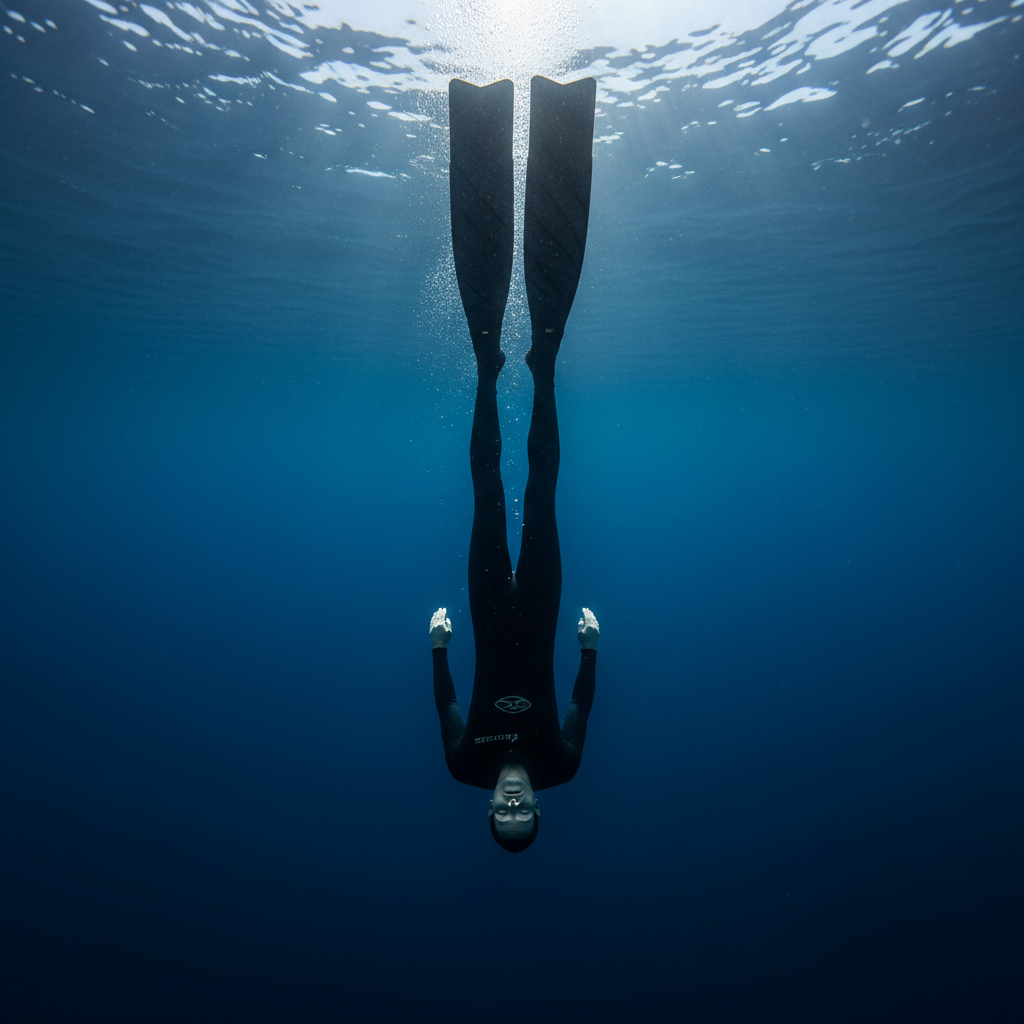
At the surface, a correctly weighted freediver should be slightly positive — floating easily without effort. As they descend and exhale during the dive, body volume decreases due to lung compression (governed by Boyle's Law: as pressure doubles, gas volume halves), and the wetsuit neoprene compresses. The result is a predictable 'crossover point' — typically between 10 and 20 metres for most freedivers in a standard 3–5mm suit — where the diver transitions from positive to negative buoyancy and begins to sink passively without finning. This is the coveted 'freefall' phase, where the diver simply relaxes and lets physics do the work.
Freedivers calibrate their weighting to hit this crossover at the right depth for their target dive. For recreational breath-hold divers doing 10–15m dives, slightly positive surface buoyancy with a crossover around 8–10m is ideal. Competitive freedivers targeting 30m+ often aim for a crossover at 10–15m to maximise the passive descent phase. The calculation involves body composition, wetsuit thickness, neck weight placement, and belt position. Many experienced freedivers use a 'weighting dive' at the start of a session — descending to 10m and holding an exhale to check if they are neutrally buoyant at that depth without finning. Adjust accordingly. Getting this right conserves oxygen, slows heart rate, and makes every dive feel meditative rather than mechanical.
Gear Choices That Make (or Break) Your Buoyancy
Equipment plays a massive role in how easily you achieve neutral buoyancy, and the right choices vary by discipline. For scuba divers, the type of BCD matters more than many people realise. Jacket-style BCDs (the most common recreational type) distribute air around the sides and back, which can force you into a slightly head-up position. Back-inflate BCDs and wing systems keep the gas volume behind you, naturally promoting horizontal trim — a significant advantage for reef diving and underwater photography.
Wetsuit choice is equally important. A suit that's too thick for the water temperature isn't just hot — it loads you with excess positive buoyancy that requires more lead to counteract, creating a heavier, less efficient system. Aim for the minimum appropriate thickness for your dive profile. Dry suit divers face an additional buoyancy variable: the air volume inside the suit, which must be managed actively throughout the dive using the dry suit's inflation valve and exhaust valve in tandem with the BCD.
For freedivers, low-volume masks reduce the amount of air needed for mask equalisation (less gas lost = more stable buoyancy), and open-cell wetsuits with smooth interior surfaces compress more uniformly than closed-cell suits, giving a more predictable buoyancy profile at depth. Neck weights — small lead weights worn at the throat rather than on a hip belt — are popular among freedivers because they counteract the tendency of a compressed wetsuit to push the legs down at depth, helping maintain streamlined body position during freefall.
Building the Skill: Drills, Practice, and the Mindset of Flow
Buoyancy mastery is not a certification you earn — it's a habit you build through deliberate practice. The good news is that targeted drills produce rapid improvement, even after just a few dedicated sessions.
For scuba divers, the peak performance buoyancy specialty course (offered by PADI, SSI, and NAUI) is genuinely worth doing, even for experienced divers. Core drills include the hula hoop hover (maintaining position inside a vertical ring), the fin pivot (pivoting on inflated BCD without touching the seafloor with fins or hands), and buoyancy obstacle courses that force precise depth control. Practice these in a pool or shallow sandy area before taking them to the reef. Videoing yourself on a dive is extraordinarily revealing — most divers are shocked by how much they kick, drag, and flail compared to how they feel in the moment.
For freedivers, yoga and breathwork practices — particularly diaphragmatic breathing and body scan relaxation — translate directly into better body awareness underwater. The mammalian dive reflex (the physiological response that slows heart rate and redirects blood to core organs during breath-hold diving) is enhanced by relaxation; tension and anxiety suppress it. Instructors from the AIDA and Molchanovs freediving systems both emphasise 'body awareness meditation' as core training alongside pool work. Practicing static apnea (breath-hold floating face-down in a pool) builds both lung capacity and the visceral understanding of how your body relates to the water — the first real step toward that floating, weightless sensation every diver chases.