Threads of Gold: How to Navigate, Read, and Respect a Kelp Forest Dive
27 May 2026location guide
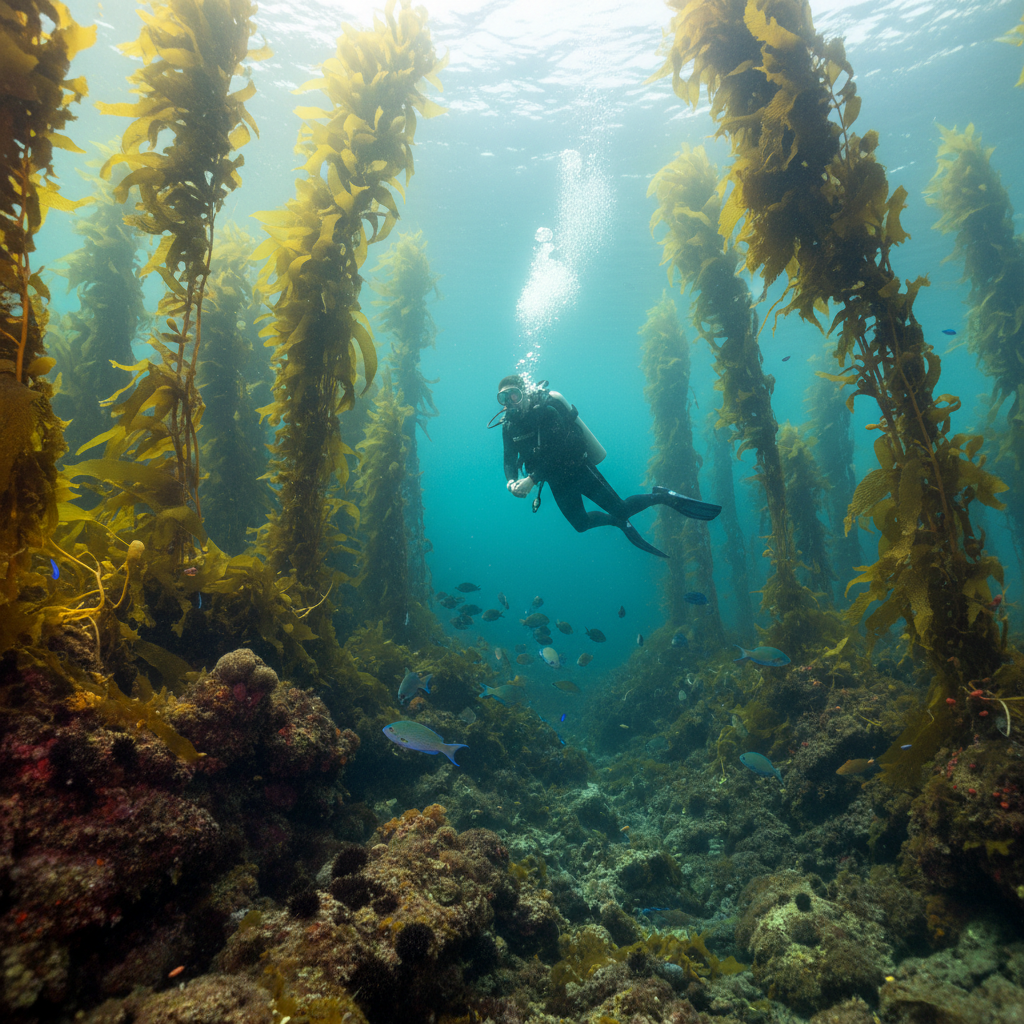
Kelp forests are among the ocean's most breathtaking — and disorienting — dive environments, where visibility shifts in seconds and the canopy plays tricks on your sense of direction. Master the navigation techniques, buoyancy skills, and ecological awareness that separate a stress-free kelp dive from a tangled, air-burning nightmare.
Why Kelp Forests Demand a Different Mindset
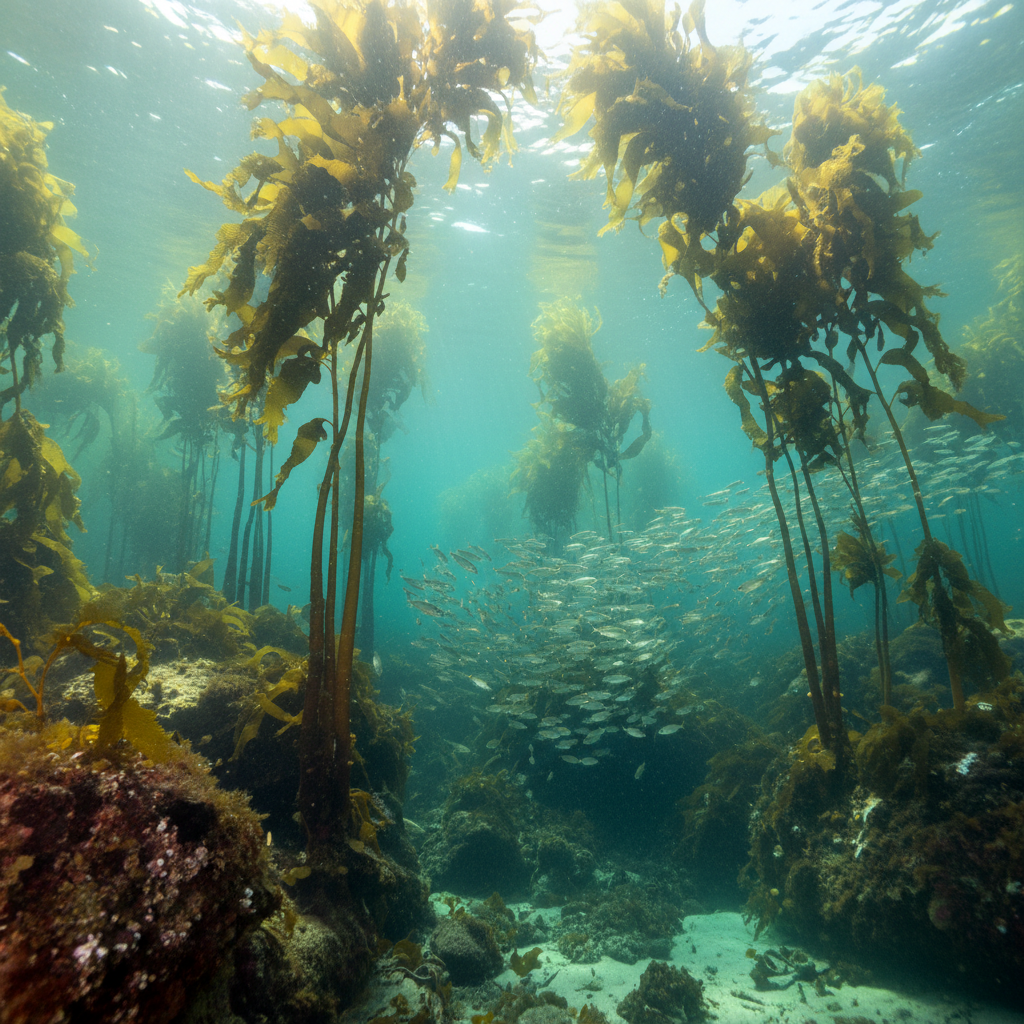
Step into a kelp forest and you've entered one of the most structurally complex ecosystems on the planet. Giant kelp (*Macrocystis pyrifera*) and ecklonia species — including the bull kelp (*Durvillaea potatorum*) common along southern Australian coasts — can grow at up to 30 centimetres per day under ideal conditions, forming dense vertical columns that stretch from the seafloor to the surface. The result is an underwater cathedral: shafts of filtered green-gold light, schools of blue-throated wrasse and blue-throated leatherjackets hovering in the mid-water, and a canopy overhead that moves like a living ceiling.
But that same beauty creates real navigational challenges. Unlike a coral reef with clear swim-throughs or an open sand flat, a kelp forest obscures your horizon, dampens ambient noise, and can physically impede your movement if you're not careful. Surge — the oscillating back-and-forth water movement caused by surface swells passing overhead — is amplified beneath a kelp canopy, pushing fronds across your path and shifting your orientation between breaths. For freedivers and spearfishers who rely on breath-hold efficiency, this surge can quietly double your oxygen consumption before you've noticed.
The first rule of kelp forest diving is this: slow down before you even enter the water. Study the surface canopy from the boat or shore. A tightly packed, rust-brown surface mat signals dense forest below. Gaps in the canopy mark clearings — often created by storm damage, sea urchin barrens, or natural senescence — and these become your highways.
Navigation Fundamentals: Compass, Canopy, and Current
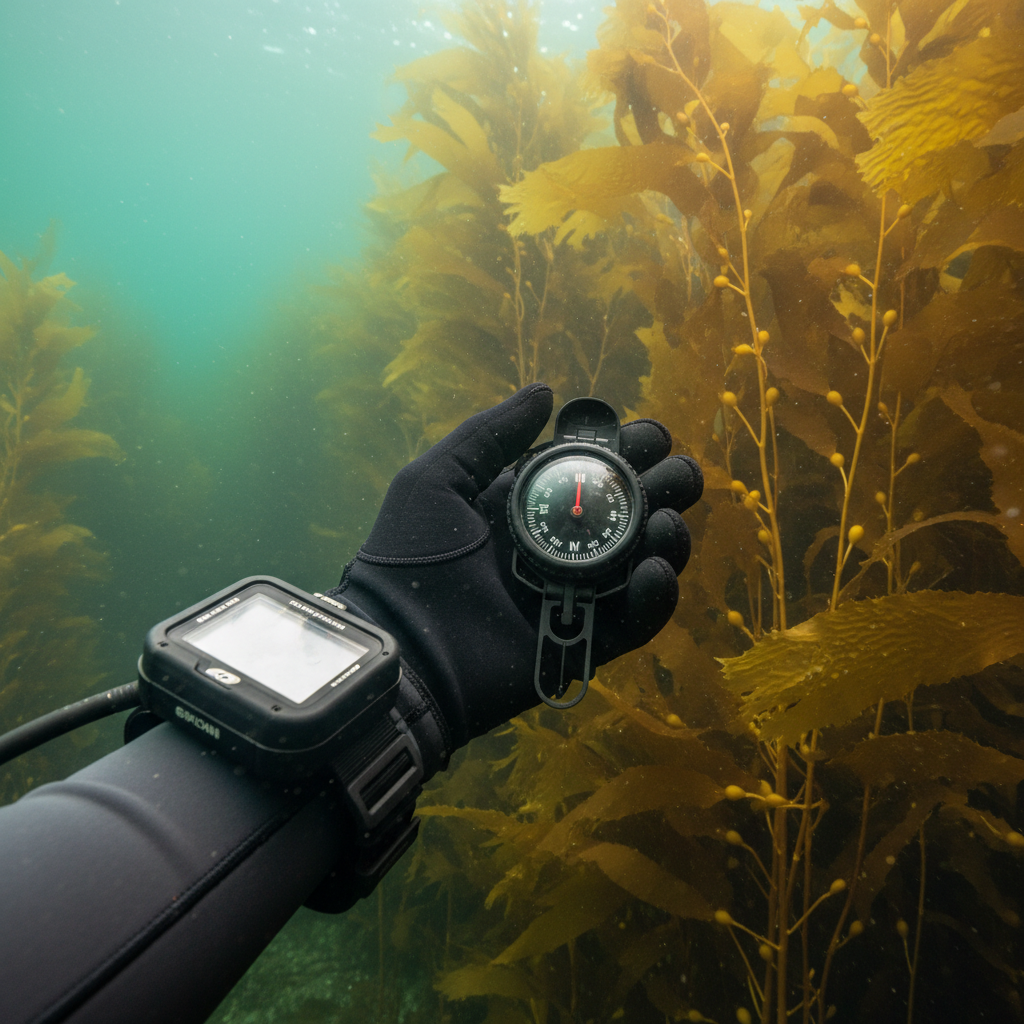
Traditional compass navigation still works in a kelp forest, but it needs to be paired with environmental cues. Before descending, take a bearing from your entry point to your planned exit — whether that's a boat, a beach, or a specific reef structure. Note the sun angle if visibility allows; even diffuse light filtering through the canopy creates a directional gradient you can track with practice.
One of the most reliable kelp-specific navigation techniques is canopy reading. As you swim at mid-water depth, the stipes (the rope-like stems of kelp) all lean slightly in the direction of the prevailing current or surge. They're essentially living compasses. Similarly, fronds at the surface orient downflow, so a glance upward gives you a real-time read on water movement. Experienced divers use this constantly — if the stipes are pushing northeast, your drift back to the anchor is likely southwest. This technique is widely taught by dive instructors working the Fleurieu Peninsula in South Australia and the rocky reefs of Victoria's Mornington Peninsula, where kelp forests are thickest.
Depth control is your other navigation ally. In dense kelp, descending to the substrate often reveals dramatically better visibility than the mid-water zone, where loose fronds and particulate matter accumulate. The bottom is also where reef structure — rock outcrops, gutters, sand channels — gives you genuine positional reference. For scuba divers, maintaining neutral buoyancy at 1–2 metres above the substrate lets you follow the reef's contour like a map. For freedivers and spearfishers, this bottom-hugging approach also puts you in the zone where most target species like blue groper, snapper, and Australian salmon hold station.
Buoyancy and Entanglement: Staying Clean in the Canopy
Buoyancy control isn't just a comfort issue in kelp — it's a safety issue. A diver who is even slightly overweighted and compensating with a partially inflated BCD will have a larger buoyancy envelope, meaning more subtle depth changes per breath or stroke. In kelp, that can mean the difference between gliding cleanly through a gap in the fronds and snagging your tank valve, fin straps, or console hose.
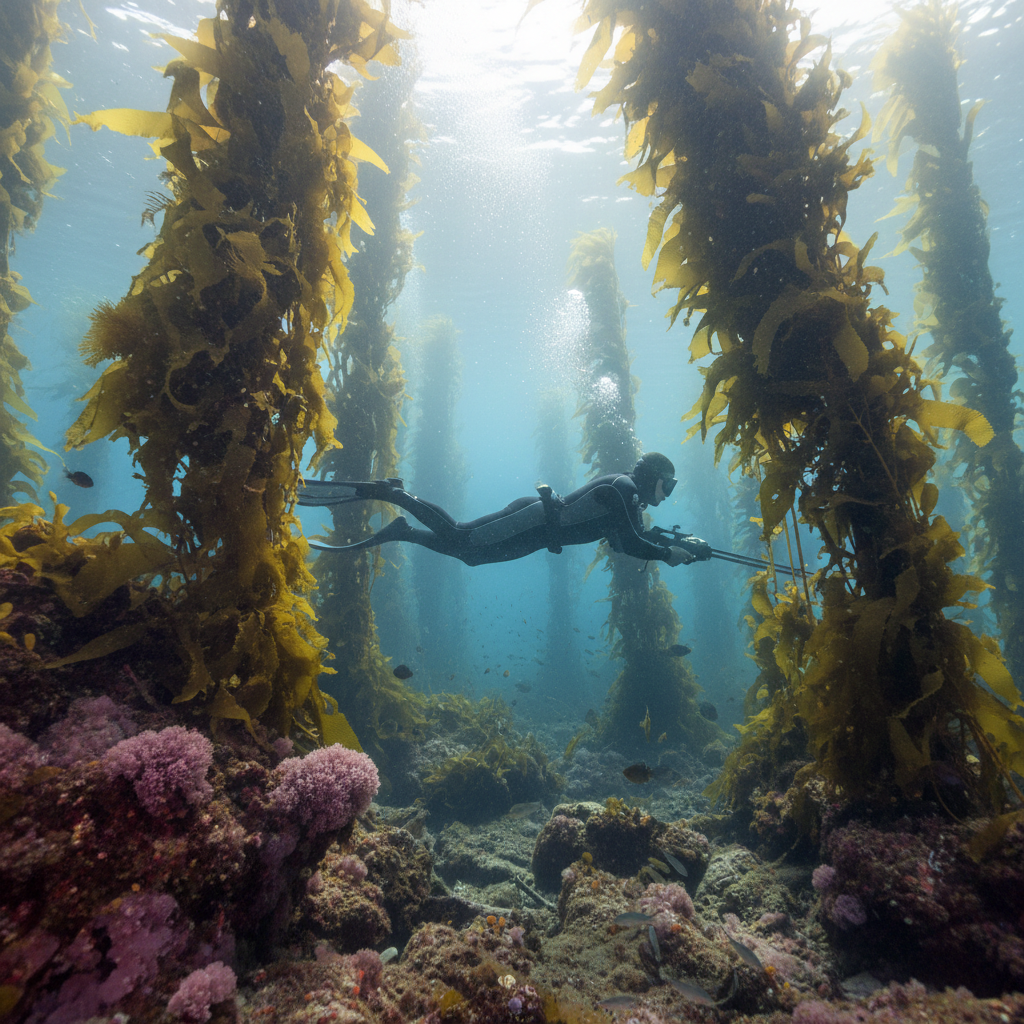
The practical advice here is to streamline ruthlessly before entering a kelp forest. Tuck consoles, computers, and gauges inside your arm or clip them flush to your BCD. Avoid drysuits with loose inflation hoses if possible. Freediving and spearfishing gear is inherently lower-profile, but spearguns require careful handling — always carry your gun muzzle-down or parallel to your body when threading through stipes, never pointed forward, and with the safety firmly engaged.
If you do become entangled — and at some point, everyone does — the golden rule is stop, breathe, think. Fighting kelp only wraps it tighter. Kelp is genuinely strong: a single mature stipe can withstand tensile loads of several kilograms before snapping. Instead, reach back to identify the snag point (almost always a buckle, fin strap, or tank valve), and slowly rotate toward the tension. A small stainless dive knife or line cutter worn on the forearm — not buried on your calf — should be accessible for genuine emergencies. Most entanglements, however, resolve with patience rather than cutting.
Reading the Ecosystem: What Kelp Health Tells You About the Dive
A kelp forest isn't static — it's a dynamic ecosystem that broadcasts its health and recent history in ways a trained eye can read before and during a dive. Dense, upright, amber-brown stipes with full blade coverage indicate a healthy, actively growing forest. By contrast, bleached or sparse kelp often signals elevated sea surface temperatures — a pattern that has become increasingly common along south-eastern Australian coasts during La Niña to El Niño transitions, as documented in CSIRO and IMAS (Institute for Marine and Antarctic Studies) monitoring data through 2024–2025.
The presence of long-spined sea urchins (*Centrostephanus rodgersii*), whose range has been extending southward along the NSW and Victorian coasts due to the East Australian Current strengthening, is a key indicator of potential "urchin barrens" — zones where overgrazing has stripped the reef of kelp entirely. These open, rubble-and-coralline-algae zones are actually excellent visibility clearings for navigation, but they signal ecological stress. For spearfishers, the Reef Life Survey (RLS) program and state-based regulations increasingly recognise the role of culling invasive urchin populations as part of reef restoration — check local regulations before any take.
For all divers, healthy kelp means rich birdlife and baitfish above the surface — gannets diving near the canopy are a reliable surface indicator of productive water below. Underwater, schooling fish concentrations near clearings or surge channels are a predictable pattern. Blue-throated wrasse and the iconic blue grouper (*Achoerodus viridis*) hold near the base of stipes; leatherjackets work the mid-canopy; snapper and sweep school in the clearings. Understanding these microhabitat preferences turns a navigation dive into a genuine wildlife encounter.
Planning Your Kelp Dive: Conditions, Timing, and the Right Gear
Timing is everything in a kelp forest. The ideal conditions combine low swell (under 1.0–1.2 metres for most southern Australian sites), light or no wind, and incoming or slack tide — which settles suspended particulate and maximises visibility. Post-storm dives in kelp are generally poor: broken fronds create a thick bio-soup in the water column, surge is unpredictable, and surface canopy damage increases the risk of descending into an entanglement zone. VisPro Dive's swell period data is particularly useful here — a 12-second swell period at 0.8m is far more manageable than a 6-second period at the same height, because longer-period swells produce slower, more predictable surge beneath the canopy.
For scuba, a low-profile single-tank configuration with a back-mounted BCD is preferable over a wing style in kelp — the reduced lateral profile slips through gaps more cleanly. A reel or safety sausage (SMB) is essential for surfacing through a canopy: inflate your SMB at depth and let it thread upward through the fronds before you ascend, giving you a clear path to follow and a visual marker at the surface for your boat or buddy. For freedivers and spearfishers, a float and flag line keeps you visible to boat traffic and acts as an anchor point between dives.
Finally, leave the kelp as you found it. A single diver with poor buoyancy can strip fronds from multiple stipes in a single dive, and kelp blades, once removed, don't regenerate from the stipe — the whole frond must regrow. Given the documented pressures on southern Australian kelp ecosystems from warming waters, reduced upwelling, and urchin barrens, every diver who moves carefully through the forest is actively contributing to its preservation. Treat it like the ancient, irreplaceable ecosystem it is — and it will keep rewarding you with some of the best diving on the planet.