Ride the Rhythm: How Spring and Neap Tides Make or Break Your Dive
10 May 2026scientific
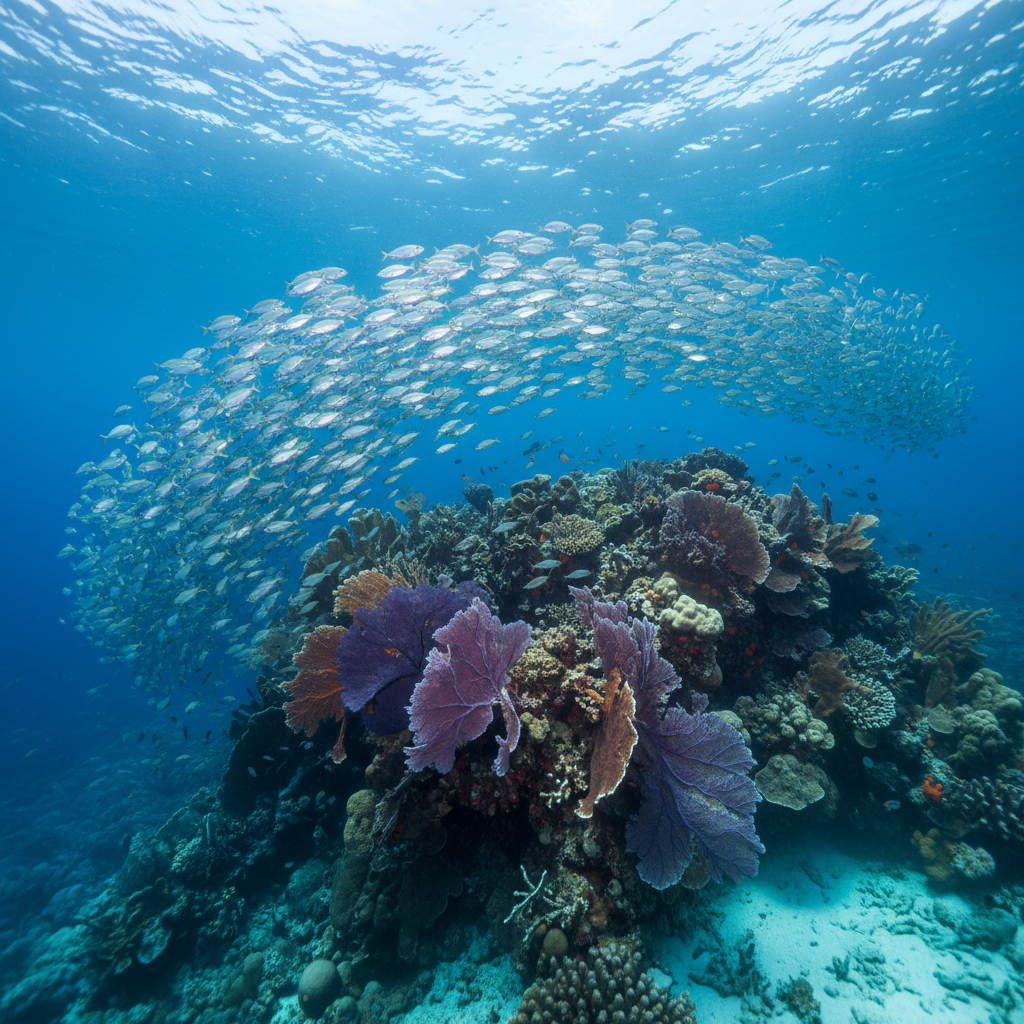
The ocean breathes on a lunar schedule — and the divers who understand that rhythm are the ones who find glassy water, ripping current, and fish-stacked reefs. Here's your complete guide to reading tidal cycles and timing your entries like a pro.

The Moon Is Your Dive Planner
Every diver has had one of those days: you rock up to a site you've dived a dozen times and the water looks like it's draining out of a bathtub. Viz is down, current is ripping, and the fish have vanished. Nine times out of ten, the culprit isn't bad luck — it's the tide. Specifically, it's probably a spring tide you didn't account for.
Tides are driven primarily by the gravitational pull of the Moon, with a secondary contribution from the Sun. As the Earth rotates, the Moon's gravity tugs on the ocean, creating a bulge of water on the side facing the Moon and, due to inertial forces, a corresponding bulge on the opposite side. These bulges sweep around the planet as it spins, producing the familiar cycle of high and low tides — roughly two of each per day in most locations (a semi-diurnal pattern), though some regions experience diurnal or mixed patterns depending on local geography.
What makes tides genuinely useful for dive planning isn't just knowing when it's high or low — it's understanding how the lunar cycle amplifies or dampens the whole system. That's where spring and neap tides come in, and once you understand them, you'll never look at a tide chart the same way again.
Spring Tides: Maximum Energy, Maximum Drama
Spring tides have nothing to do with the season. The name comes from the Old English 'springan' — meaning to leap or surge — and that's exactly what the water does. Spring tides occur during new moon and full moon phases, roughly every two weeks, when the Sun, Earth, and Moon align in a configuration called syzygy. In this alignment, the Sun's gravitational pull reinforces the Moon's, producing tidal ranges significantly greater than average — sometimes 20–40% higher than mean tidal range.
For divers, this translates to fast, powerful tidal currents. The greater the difference between high and low tide, the more water has to move through channels, over reefs, and around headlands in the same amount of time. In narrow passages or constricted bays — think the passages around the Whitsundays, Bass Strait choke points, or the narrow channels of the Kimberley coast — spring tides can generate currents exceeding 4–5 knots. That's beyond the swimming ability of most divers and actively dangerous for freedivers and snorkellers.
That said, spring tides aren't all bad news. For spearfishers, strong tidal flow aggregates baitfish at current breaks, which stacks pelagic species like trevally, mackerel, and amberjack in predictable feeding lanes. Experienced spearos often time their dives to the last hour of the outgoing spring tide specifically to target these aggregations. The key is slack water — the brief window at the turn of the tide when current velocity drops to near zero before reversing. Even on a big spring, slack water typically lasts 20–40 minutes and can offer some of the most productive diving of the month.
Neap Tides: The Diver's Sweet Spot
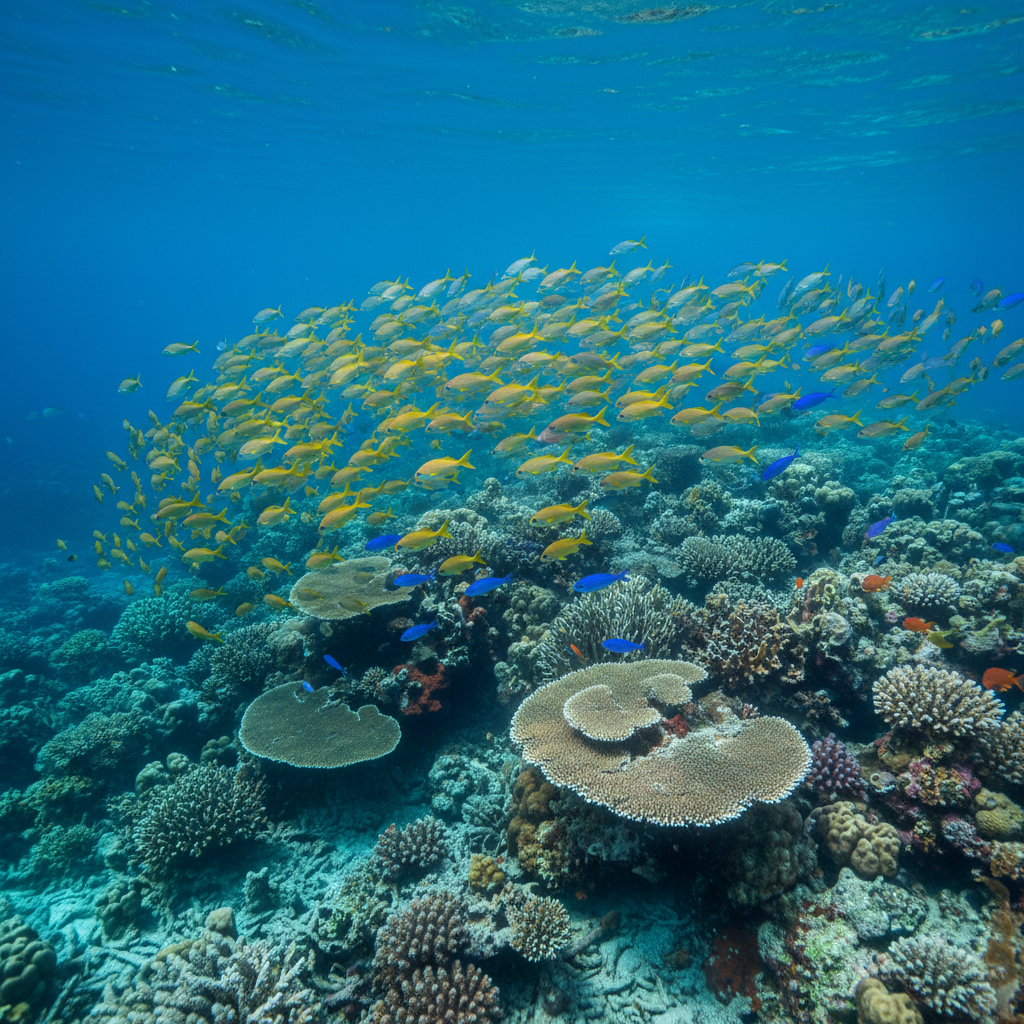
If spring tides are the ocean's deep breath, neap tides are its exhale. Neap tides occur during the first and third quarter moon phases, when the Sun and Moon are at roughly 90-degree angles to each other relative to Earth. Their gravitational pulls partially cancel out, producing the smallest tidal range of the lunar cycle — often 10–30% below average. Less range means less water moving, which means slower currents, more stable conditions, and — crucially — better visibility.
Neap tides are the sweet spot for most recreational diving. Reduced current means beginners can focus on buoyancy and breathing rather than fighting the water column. Visibility improves because sediment and particulates aren't being churned off the bottom and stirred through the water column by tidal energy. In turbid coastal environments like Port Phillip Bay or the broader Great Barrier Reef lagoon, the difference between diving a neap and a spring can mean 3 metres of visibility versus 12 metres. That's the difference between a frustrating dive and a genuinely extraordinary one.
For freedivers and snorkellers in particular, neap tides are the planner's first filter. Without SCUBA equipment to compensate for current, you're far more exposed to tidal energy. A neap tide at a site like Magic Point in Sydney or the Blairgowrie Pier in Victoria gives you gentle drift, extended surface intervals, and the kind of relaxed conditions that let you drop into the meditative state that makes freediving so special.
Reading the Chart: Tidal Windows and the Rule of Twelfths
Knowing that spring and neap tides exist is one thing. Being able to extract a usable dive window from a tide chart is where the real skill lies. The single most useful tool for this is the Rule of Twelfths — a simple approximation of how quickly water rises or falls during each hour of a six-hour tidal cycle.
The rule works like this: in the first hour after low (or high) tide, the water moves roughly 1/12 of its total tidal range. In the second hour, 2/12. In the third and fourth hours — the middle of the cycle — it moves 3/12 each, meaning the water is rushing fastest at mid-tide. In the fifth hour it slows to 2/12, and in the sixth it trickles through the last 1/12 to high (or low). So if you're diving a site with a 2-metre tidal range, the current will be moving most aggressively in hours 3 and 4 of the cycle. Planning your entry for the first or last hour — when only a small fraction of that tidal volume is moving — gives you the gentlest conditions even on a moderate spring tide.
Australia's Bureau of Meteorology (BOM) provides free, accurate tide predictions for hundreds of locations around the coast, and apps like VisPro Dive overlay this data directly onto site-specific dive condition forecasts. Cross-referencing your local tide tables with real-time current and swell data before any dive — not just checking 'high tide at 9am' — is the kind of pre-dive habit that separates prepared divers from unlucky ones.
Tides, Viz, and the Biological Bonus
The relationship between tidal phase and underwater visibility is deeply tied to sediment dynamics. During spring tides, energetic bottom currents resuspend fine sediment, particularly in shallow, sandy, or silty environments. This is why dive sites over seagrass meadows or sandy rubble — common in southern Australia — can deteriorate dramatically around big spring tides even without any rain or wind. The mechanism is purely hydraulic: fast water picks up fine particles and holds them in suspension, scattering light and collapsing horizontal visibility.
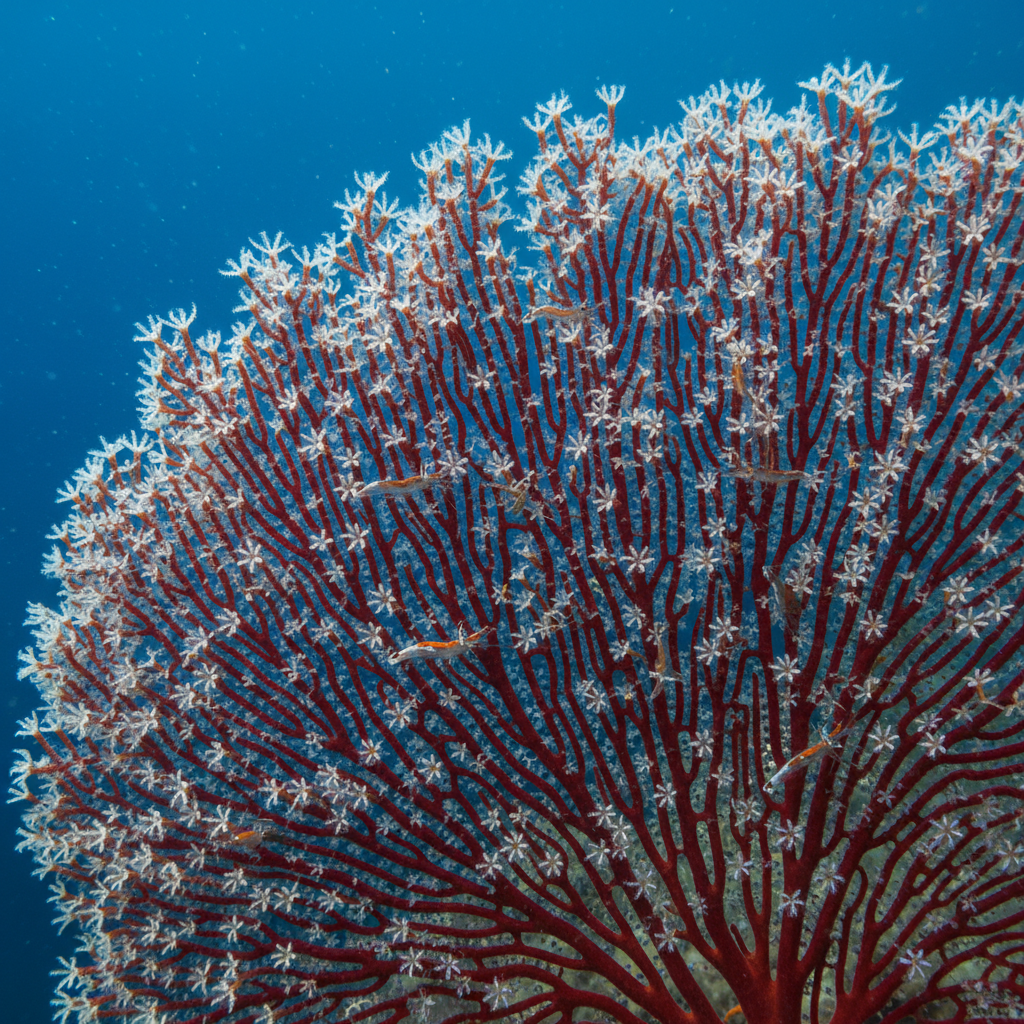
But tides do something else biologically that divers should absolutely exploit. Tidal flow is the ocean's food-delivery system. Plankton, larvae, and nutrients are transported by tidal currents, and the animals that eat them position themselves accordingly. Hard corals and filter feeders like sea fans, crinoids, and sponges orient their feeding surfaces into the current for exactly this reason. Tidal upwellings — particularly pronounced around seamounts and continental shelf edges — bring cold, nutrient-rich water to the surface, triggering feeding frenzies that can attract manta rays, whale sharks, and schooling pelagics. Knowing that a spring tide is building doesn't just warn you about current — it tells you that the reef is about to come alive.
For night divers, the connection is even more direct. Many invertebrates — nudibranchs, crustaceans, cephalopods — time their activity to tidal phase and lunar light levels. Diving during the darker nights of a new moon spring tide (when there's no moonlight) over a healthy reef often produces extraordinary invertebrate activity, because both reduced light and tidal flow trigger emergence behaviours. It's counterintuitive that the most current-prone phase of the lunar cycle can also be one of the most biologically spectacular — but that's the ocean for you.
Putting It All Together: A Pre-Dive Tidal Checklist
Planning around tidal patterns doesn't need to be complicated, but it does need to be deliberate. Before any dive — recreational SCUBA, freedive, spearfish, or snorkel — run through this quick mental checklist: Where are we in the lunar cycle right now? Are we approaching a spring or a neap? What is the tidal range at this specific site today? What time is high and low tide, and when is slack water? And critically — what are the local geography and exposure like at this site?
That last point matters enormously. A site inside a sheltered bay will behave very differently to an exposed headland or a channel between two land masses, even under identical tidal conditions. Local knowledge — from dive shops, charter operators, or experienced dive community members — is irreplaceable for understanding site-specific tidal quirks. Some sites actually fish best on the run-in spring tide; others are completely undiveable except during neap slack. There is no substitute for knowing your site.
Finally, never treat a tidal plan as a rigid contract with the ocean. Conditions evolve — wind can oppose or amplify tidal current, swell can make entries hazardous regardless of tide, and unexpected upwellings can change water temperature and visibility rapidly. Build flexibility into your plan, always have a bail-out site or activity in mind, and remember the golden rule: the ocean doesn't care about your schedule. Dive when conditions are right, not just when they're convenient. The divers who truly understand tidal rhythms don't fight the ocean — they move with it.